


It is one of the most repeated pieces of phone advice on the internet: drop your phone in water, then bury it in a bowl of rice and wait. We have heard it from nearly every customer who walks into our Clarendon lab with a liquid-damaged device. We understand why it persists. It feels like you are doing something. The truth, after eleven years of opening up these boards under a microscope, is that rice does close to nothing useful, and the delay it encourages is often what costs people their phone and their data.
What Rice Actually Does (Almost Nothing)
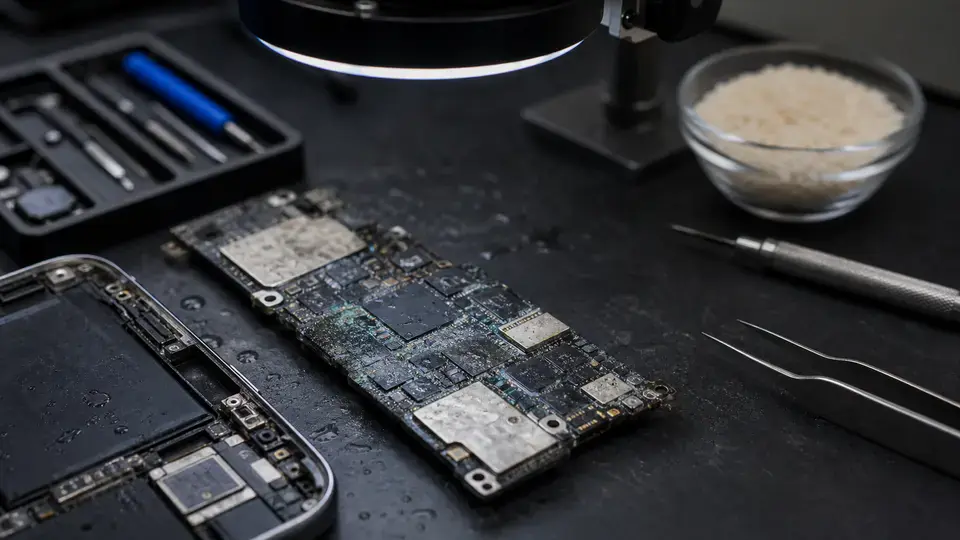
The idea behind rice is that it acts as a desiccant and pulls moisture out of the device. In reality, rice is a slow, weak absorber that can only touch air sitting in open ports. It cannot reach water trapped underneath chips, beneath shields, or sealed inside the layers of a logic board. By the time rice has pulled a meaningful amount of moisture from the surrounding air, the damage inside has already been done.
Independent testing in recent years has consistently shown rice performing worse than simple passive airflow, and far worse than silica gel. Worse still, rice introduces its own problems: starch and dust work into the charging port and speaker mesh, and once that powder gets damp it turns into a paste that is harder to clean off a board than plain water ever was. When we open a phone that has spent two days in rice, we are often cleaning up two messes instead of one.
The Real Enemy Is Corrosion, Not Water
Here is the part the rice advice completely misses. Water itself is not what kills a phone. Two separate things do. The first is an immediate short circuit, which happens when liquid bridges two points that should never be connected while the board is powered. The second, and the one almost nobody plans for, is corrosion.
Tap water, pool water, salt water, and especially soda or coffee carry minerals and ions. When those settle on the tiny exposed metal pads and traces of a logic board, they start an electrochemical reaction. That reaction does not stop when the phone feels dry to the touch. We see it most often clustered around the PMIC, the Tristar/Tigris U2 charging IC, and the audio IC, where a single corroded leg or a lifted pad can take down charging, the display backlight rail, or the mic.
The phone can power on, look completely normal, and then fail days or weeks later. That is not bad luck. That is corrosion quietly eating through a connection that water started and air finished.
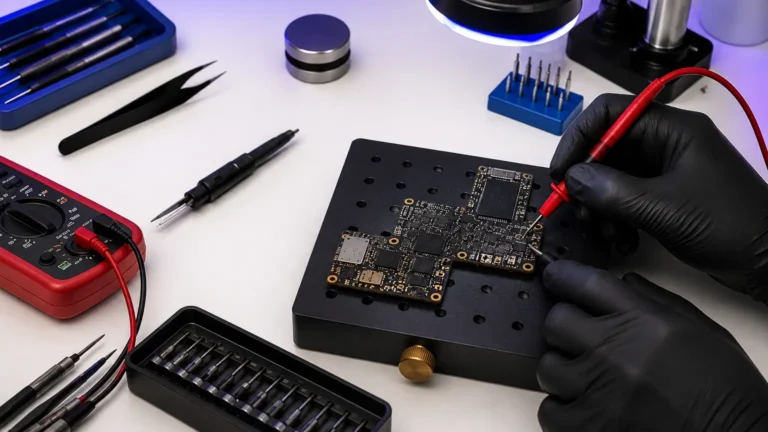
Of the last ~50 liquid boards we opened at the Repair Center, the dead ones rarely failed from the original splash. They failed from green corrosion that kept spreading under a shield for days. At a Repair Center PSU a healthy board might draw 0.00A at rest and pull a clean spike when you trigger boot; a corroded one often sits at a dead short, or drifts up drawing current on a rail that should be quiet, both signs the reaction is still live inside.
This is why we treat liquid exposure as an ongoing chemical process, not a one-time event. The clock that matters is not “is it dry yet.” It is “how long has corrosion had to spread.”
What To Actually Do In The First Minutes
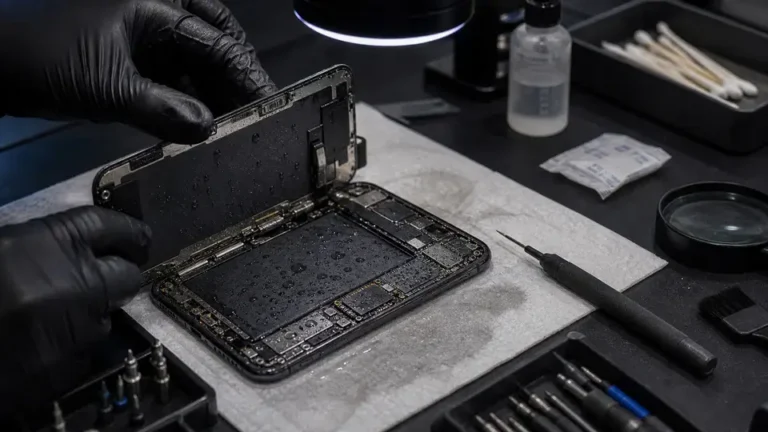
If your phone gets wet, the goal is to stop both failure modes: cut the power to prevent shorts, and limit how long minerals sit on the board. Here is the short list we give everyone who calls us.
- Power it off immediately. Do not wait to “check if it still works.” Every minute powered on with liquid inside is a chance for a short.
- Do not charge it. This is the single most damaging thing people do. Pushing current through a wet board is how a recoverable phone becomes a dead one. Do not charge it, and do not plug it into anything.
- Skip the rice, skip the hair dryer. Heat can warp components and drive moisture deeper. Rice just wastes time.
- Stand it upright with the ports facing down in a dry, airy spot so gravity helps drain it.
- Get it to a lab fast. Speed matters more than any home trick. The sooner the board is cleaned, the more of it survives.
If you only remember two things, remember power it off and do not charge it. Those two choices decide more outcomes than anything else.
How Board-Level Cleaning Works
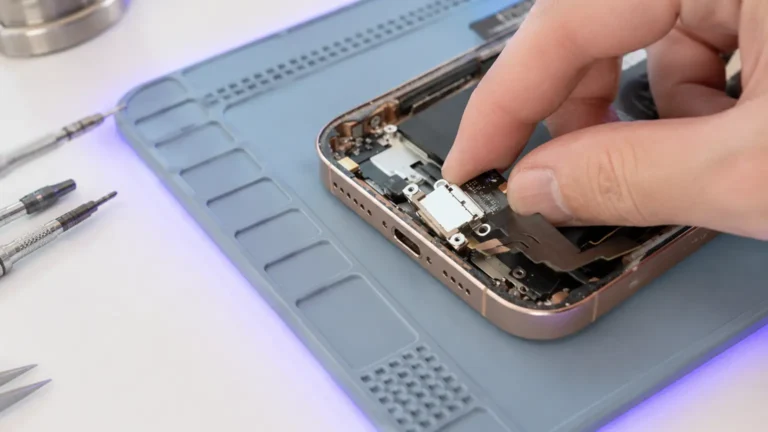
When a liquid-damaged device reaches us, we do not gamble. We pull the shields, inspect the board under the microscope, and check suspect rails in diode-mode to find shorts before we ever apply power. The actual cleaning is done in an ultrasonic bath, where high-frequency sound creates microscopic bubbles that lift corrosion and mineral deposits off the board, including from underneath BGA chips where no cotton swab can reach. From there we treat affected areas, reball or replace components that are too far gone, and rebuild destroyed connections, sometimes running a fine jumper wire to bypass a trace that corrosion has eaten clean through.
This is genuine board-level work, not the “wipe it down and hope” approach. You can read more about how we handle water damage repair across every device we service, and we have a dedicated process for iPhone water damage repair specifically, since Apple’s sealed assemblies need their own careful disassembly.
Data First, Always
For most people, the panic is not really about the hardware. It is about the photos, messages, and accounts living on the device. So our first priority on any liquid job is stabilizing the board enough to get your data off safely, before we worry about long-term repair. If the phone can be revived through its normal interface, that is the cleanest path. If it cannot, board-level data recovery is the next step.
This is also why the rice delay is so costly. Every day a corroded board sits untreated, the odds of a clean data extraction drop. The phone that “still turned on” after the weekend in rice is frequently the one that fails at the Repair Center a week later, with corrosion now sitting on the very memory connections we need.
What We Charge And What We Promise
Every liquid-damage device gets a written diagnostic so you know exactly what we found and what it will cost before any repair begins. That diagnostic is a flat $65, and it applies toward your repair if you go ahead with the work. No guessing, no surprise totals. Our repairs are backed by warranty, and we never sell or share your data. You can come to us as a walk-in here in Arlington, or send your device in by tracked mail from anywhere in the fifty states.
Rice is not a treatment. It is a delay dressed up as one. If your phone has met liquid, power it off, leave it off the charger, and get it to a lab while corrosion is still something we can stop.