


One of the most common questions we hear at the Repair Center is also one of the fairest: “Why do you charge to look at it when the shop down the street does it for free?” It is a reasonable thing to ask. After eleven years of board-level work, our honest answer is that the $65 diagnostic is not a hurdle between you and a repair. It is the most useful thing we do for you, and it is the part of our process we are most willing to defend. So let us explain exactly what it buys, why it applies toward the repair, and why we think “free” is usually the more expensive option.
“Free diagnostics” are rarely free
The phrase sounds generous, but in the wider repair industry it usually means one of two things. Either the shop is not actually diagnosing anything, or it is making the money back somewhere you cannot see. A free look is an invitation to guess. And in electronics, guessing has a name technicians use with some embarrassment: the parts cannon. You swap the screen. That did not fix it, so you swap the battery. Then the charging port. Then the whole logic board. Each swap is billed to someone, and that someone is usually you.
The trouble is that a phone or tablet that will not turn on can have a dozen different root causes that all look identical from the outside. A dead Tristar/Tigris U2 charging IC, a shorted load cap on the main rail, a blown backlight boost converter, a corroded PMIC, none of those is visible from the outside, and the parts cannon never finds the right one. “Free” creates a quiet incentive to skip the measuring and start replacing, because replacing is what generates revenue. We would rather charge you once to find the actual fault than charge you three times for parts that were never the problem.
What a real board-level diagnosis actually is
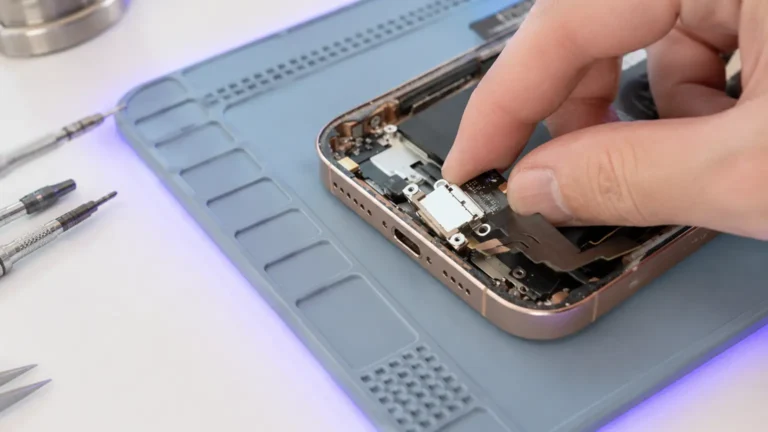
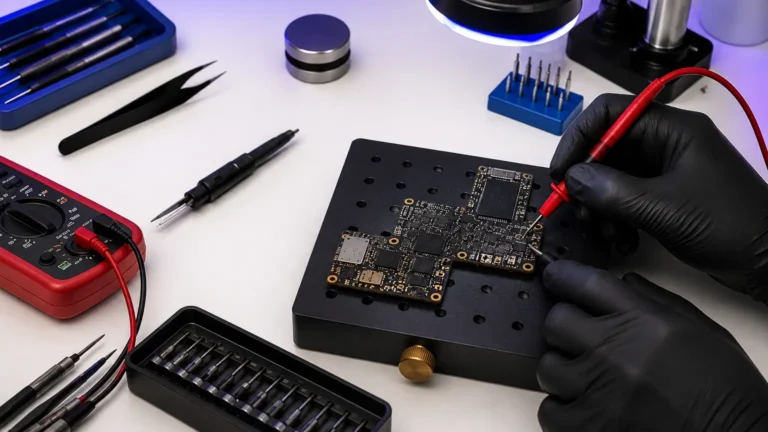
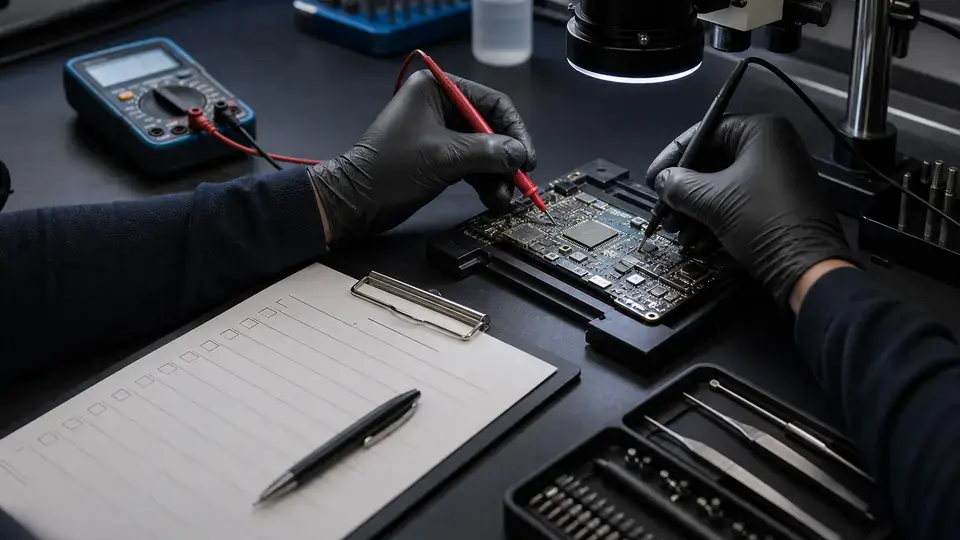
A genuine board-level diagnosis is not a glance. It is skilled Repair Center time with real instruments, and it is where most of the actual difficulty in this trade lives. On a typical no-power case, the work runs something like this:
- Under a stereo microscope, inspecting the board for green corrosion, lifted pads, missing shields, and the burn marks of a previous repair attempt.
- At a Repair Center power supply, watching current draw the instant power is applied. A board that pulls 0.00A, a board that sits at a steady short, and a board that draws then collapses are three completely different stories.
- In diode mode, reading the failing rail against the schematic and boardview for that exact model, tracing a dead PP_VCC_MAIN or a shorted line back to the specific PMIC, audio IC, or U2 responsible.
- Confirming the fault with measurements rather than assuming it, so the part we name is the part that is actually dead.
This is the same discipline behind our microsoldering work, and it takes equipment and training that most walk-in shops simply do not have. The $65 reflects that skilled time, not a markup on a part. When it is done, you do not get a shrug and a vague estimate. You get a written report stating the exact fault we found, what the repair costs, and how long it will take, all before we touch a thing.
The fee applies toward your repair
Here is the part people miss, and it changes the whole math. The $65 is not an extra charge stacked on top of the repair. It applies toward the repair. If we diagnose a failed power management chip and you approve the work, the $65 comes off the total. You are not paying for the diagnosis and then paying again for the fix. You are paying for the fix, and the diagnosis was the honest first step of it.
You only pay $65 and nothing more in one situation: when you decide not to proceed. And in that case you still walk away with a written report you can take anywhere.
So for the customer who goes ahead, the diagnostic is effectively free. The only thing it costs is the price of knowing the truth before money changes hands.
It protects you from paying for the wrong fix
The deeper reason we charge is that diagnosis protects your wallet far more than it protects ours. When you pay for parts that do not fix the problem, that money is gone. It does not come back when the next guess fails. A correct diagnosis up front means you spend once, on the thing that is actually broken.
It also means the price you are quoted is the price grounded in a real finding, not a hopeful guess that quietly grows once the device is open. We would rather lose a sale by being precise than win one by being vague and surprising you later. That is the whole bargain of charging to look first.
How it lets us tell you “it is not worth it”
This may be the most important benefit, and it only works because we are paid for the diagnosis itself. Sometimes the honest answer is that a repair does not make sense. The board has water damage across multiple layers, or the cost to fix it approaches the cost of a replacement device. A free-diagnostic shop has every reason to talk you into the repair anyway, because the repair is the only way it gets paid.
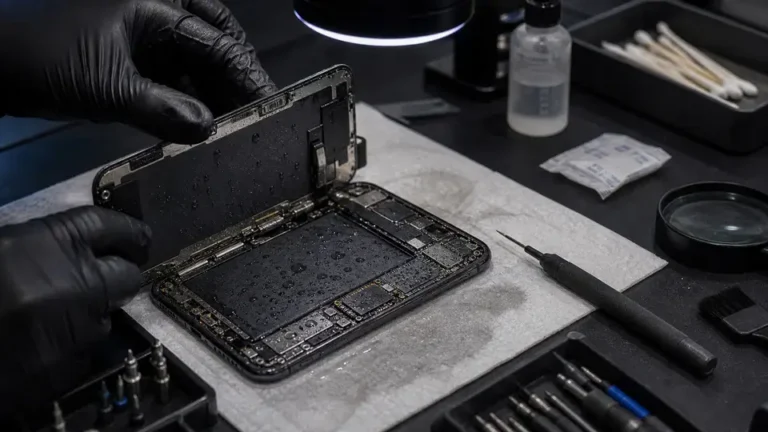
Because our diagnostic stands on its own, we can look you in the eye and say “do not spend the money on this.” Of the last ~50 liquid-damaged boards we opened, a real share had corrosion eaten under the BGA on multiple layers, the kind of job where reballing the CPU and chasing burned traces costs more than the device is worth. We can say so without flinching because we were already paid for the skilled work of finding out. The $65 is what makes a genuinely honest recommendation possible.
The same standard, every device
That standard does not change whether you walk into our Clarendon lab in Arlington or send your device through our tracked mail-in service from anywhere in the fifty states. Every board gets the microscope, the Repair Center supply, the schematics, and a written report before any work begins. If you want to understand how we operate and why we built the lab this way, the diagnostic is the clearest window into it. We charge to look first because looking carefully, and telling you the truth about what we see, is the actual job.