


A customer mailed us a 256GB iPhone 12 with a sticky note: “Three shops changed the charging port. Still dead. Trash it?” We put it at the Repair Center supply, plugged in a known-good cable, and it drew 0.00A. Not a flicker. The brand-new port those shops kept soldering in was never the problem, the Tristar IC behind it was. We replaced one BGA chip and the phone charged on the first try. That phone had three good ports thrown at a chip-level fault.
This is the single most misdiagnosed failure we see. “It won’t charge” almost always gets blamed on the port because the port is the part you can see. In 11 years at the Repair Center, the port is fine more often than not.
Port or chip, what is actually different?
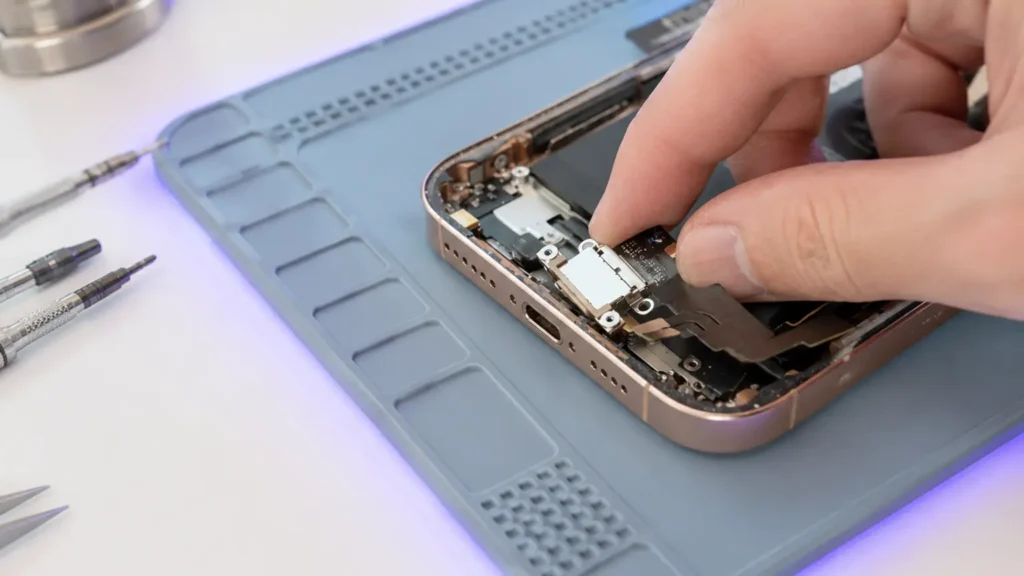
The charging port (the Lightning or USB-C connector) is a dumb mechanical part. Pins, springs, solder. It wears out, it corrodes, it bends. When it fails you usually see it: a connector packed with pocket lint, a bent pin, green corrosion on the flex, a cable that only charges if you hold it at one angle.
The charging IC, Apple calls it Tristar (Lightning-era boards) or Tigris (USB-C boards), the U2 chip, is the brain. It negotiates with the cable, authenticates accessories, and tells the PMIC it’s OK to pull power. When U2 dies, the port can be physically perfect and the phone still won’t charge, won’t show the lightning bolt, and won’t be seen by a computer. Tristar failures are classic on boards that have been hit with cheap non-MFi cables, voltage from a bad charger, or a drop.
How we tell them apart at the Repair Center
We don’t guess and we don’t shotgun parts. The sequence is the same every time.
- Repair Center power supply first. We power the board off a DC supply set to 4.2V instead of a battery, so we can watch current draw in real time. A healthy phone idles low, then climbs when it starts charging. A dead-flat 0.00A on plug-in is a strong U2 / power-line story, not a port story.
- Wiggle test under load. With the cable in and the supply watching, we move the cable. If current jumps around or only appears at one angle, that’s a mechanical port problem, a cold joint, a worn contact, a cracked flex.
- USB enumeration. We plug the phone into a computer. A working U2 enumerates, the machine sees an iPhone or at least a recovery-mode device. A dead Tristar/Tigris means the computer sees nothing at all, even though the port is wired perfectly.
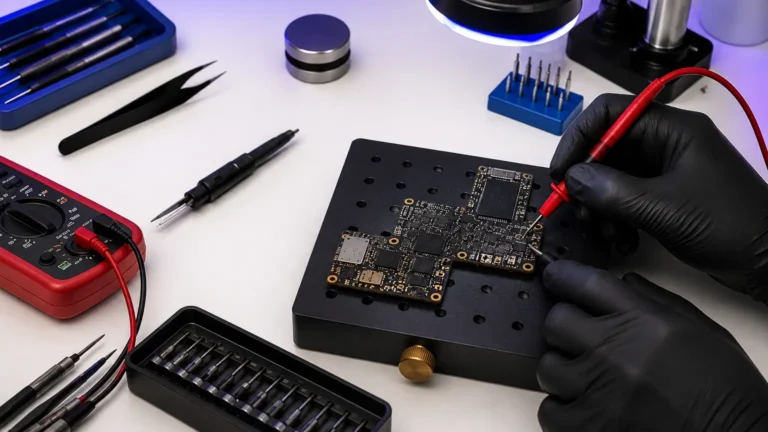
- Diode-mode on the data lines. With the board off and a multimeter in diode mode, we read the USB data lines and the lines around U2 against ground. Shorted or wildly out-of-spec readings point at the chip. A normal diode reading with a still-dead phone sends us back to the port or the flex.
Four checks, maybe ten minutes. By the end we know whether we’re soldering a connector or reballing a BGA, before we touch the iron.
What the readings actually look like
A worn port: physical damage you can see, current that appears and disappears as you move the cable, and the computer does sometimes see the phone when you hold the cable just right. Fix: replace the port flex. Cheap, fast, high success rate.
A failed Tristar/Tigris: clean port under the scope, 0.00A or a flat-line draw on plug-in, no enumeration on a computer no matter what cable, and bad diode readings on the data lines. Sometimes the phone also won’t boot or gets stuck in a reboot loop, because a shorted U2 can drag down the whole power line. Fix: microsolder a new charging IC.
The trap is the middle case, a port that looks a little tired sitting next to a phone that won’t charge. That’s exactly where shops swap the port, hand the phone back, and the customer is back a week later. The Repair Center supply settles it. If 0.00A doesn’t move with a new port plugged in loose, the new port was never going to help.
Repair vs replace, our honest take
Port replacement is a no-brainer. It’s a common, affordable repair and the part is OEM-equivalent. If your reading is a clean mechanical failure, fix it.
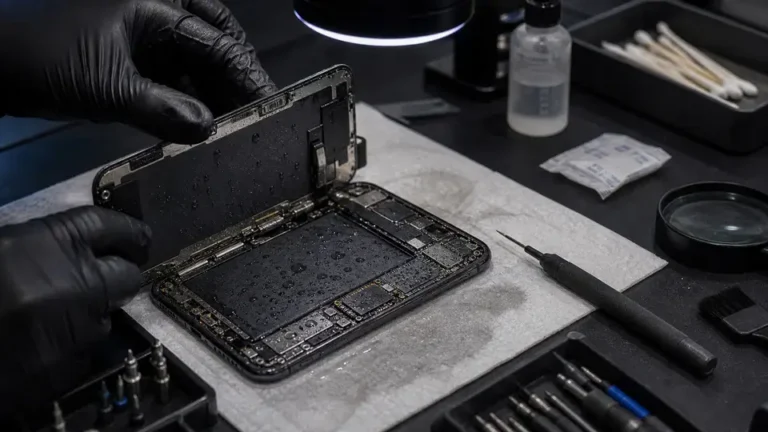
The Tristar/Tigris IC is microsoldering, pulling a BGA chip with hot air, cleaning and reballing the pads, and placing a new IC. It’s real board-level work, but it is absolutely fixable. We’d far rather charge you for one chip than have you toss a phone over a $6 part. The time we say don’t bother: when liquid or a hard drop also took out the PMIC or cooked the NAND. At that point you’re stacking chip repairs and a good used phone is the smarter spend. We’ll tell you that straight after the diagnostic, not after we’ve billed you for three repairs.
Every one of these starts with our $65 diagnostic, credited toward the repair if you go ahead. Parts carry our standard warranty, 1 year on OEM/OEM-equivalent, 30 days on aftermarket. We’re independent, not manufacturer-authorized, which is exactly why board-level repair is on the table instead of a flat “your phone is dead, buy a new one.”