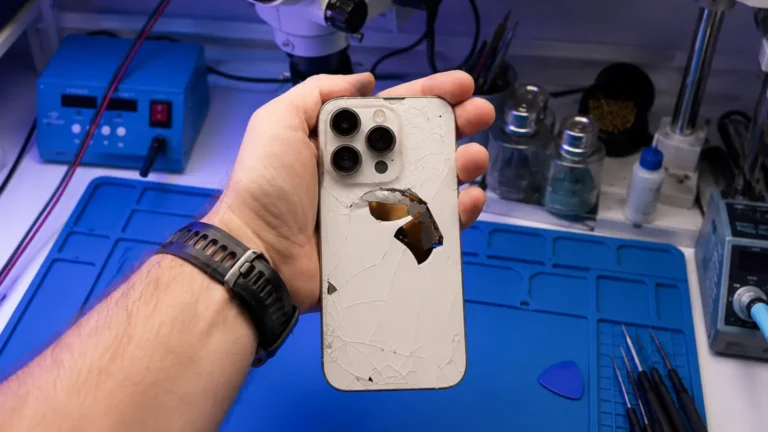



A MacBook lands at the Repair Center dead. On the PSU it draws 0.00A, no power-on sequence at all. We meter the main rail in diode mode and find a dead short to ground, 0.002V where it should read healthy. One failed power chip pulled the whole board down. The customer’s quote from the chain store was $900 for a full logic board, data gone. The actual fault was a single IC a few millimeters across. That gap is the whole story of board-level repair, and it is the part of the industry most shops would rather you didn’t think about.
What the manufacturer actually does
Walk into a manufacturer counter or a chain with a logic board fault and the path is nearly always the same: they replace the entire board. Every chip, every line, every healthy component on it, gone, because one part failed. To them the board is a single line item, fast, consistent, no diagnosis beyond “the board is bad.” A board carries the CPU, the RAM, the PMIC, the charging circuit, dozens of regulators and filters and traces, and the overwhelming majority of them were working fine when you walked in.
The price reflects the whole board, not the fault. Apple’s standard logic board service on a Mac commonly runs well into the hundreds and often past a thousand dollars, and the quote does not change whether the failure was a cracked solder joint or a dead power chip costing a few dollars. You pay for the easy answer.
What board-level repair actually is
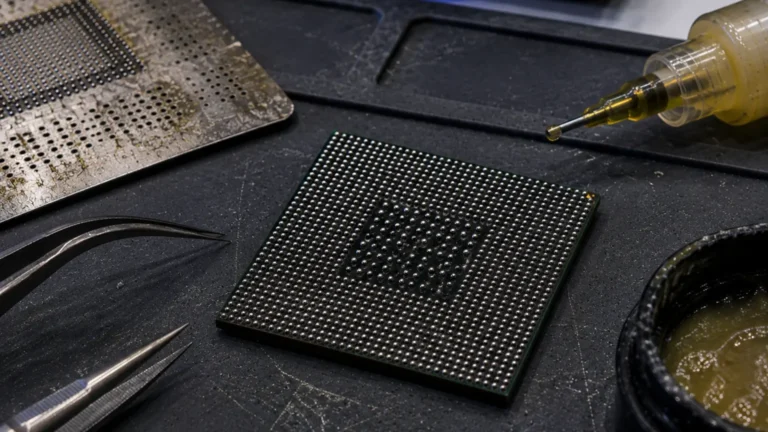
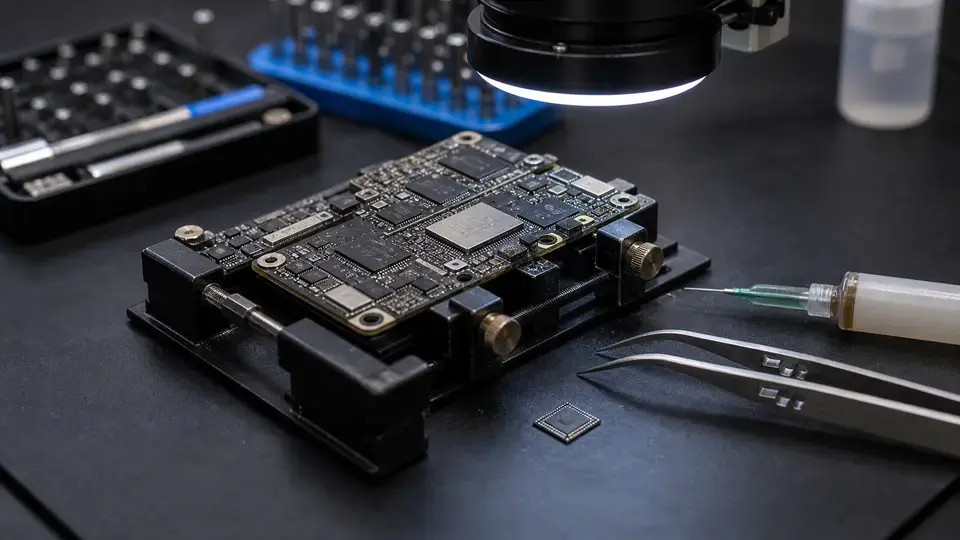
Board-level repair, sometimes called microsoldering, starts from the opposite assumption: the board is mostly fine, and our job is to find the one part that isn’t. We put the board under a stereo microscope, meter the rails at the Repair Center PSU, follow the schematic and boardview, and isolate the specific failed component, a shorted line, a dead PMIC, a charging chip like the U2/Tristar (or Tigris on newer boards), a cracked BGA joint under the processor. Then we replace or repair just that, down to a single chip.
This is slower and it takes skill, but the logic is simple: replacing a 50-cent regulator is cheaper than replacing the entire assembly it sits on. Component-level work routinely turns what a chain quotes as an $800 board swap into a fraction of that, because we charge you for the fault, not the board.
The part nobody tells you: your data
Cost is the obvious argument. Data is the one that should actually stop you. On modern iPhones and Macs, your storage is not a swappable drive. The NAND flash is soldered to the board and cryptographically paired to that board’s Secure Enclave. Your files are encrypted to the original chip set, the original storage, and your passcode together. Move the board, and the pairing breaks.
A full board swap does not transfer your data. It erases your access to it. The new board has a different identity, and the encryption that protected your files now locks you out of them permanently.
This is why the Genius Bar hands you a waiver before a board service: they are telling you, in writing, that the data may be gone. A board-level repair keeps the original board, which means it keeps the pairing, which means your photos, messages, and files come back with the device. When we fix the failed component instead of swapping the board, we are also preserving the only path back to your data.
What we do in-house that most shops mail out
Plenty of shops will tell you they do “board repair,” then quietly ship your device to someone like us. We do the hard work here, in our lab in Clarendon, under the microscope:
- BGA reballing and reflow for processors and chips whose solder ball connections have cracked, common in no-power and won’t-boot faults.
- Lifted pads and broken traces, rebuilding the copper landing points and jumpering severed lines so a chip has somewhere to sit.
- Liquid damage, where corrosion has eaten lines and bridged pins, cleaned and reconstructed at the component level rather than written off.
- Failed ICs, power management chips, charging ICs, audio and backlight boost drivers, removed and replaced individually.
If you want the full picture of what board faults we take on, our motherboard repair page lays it out. Everything stays here. Nothing about your device, and nothing about you, leaves this lab.
When a board honestly isn’t worth saving
We are not going to tell you every board can be saved, because that would be a lie. Some boards are genuinely past the point of sense: severe liquid damage that has corroded under multiple BGA chips, a board that has been worked on badly by someone else and lost critical pads, or damage so distributed that the repair cost approaches a working replacement device. When the Secure Enclave or the NAND itself is the failed part, sometimes the data is simply unrecoverable no matter what we do, and we will say so plainly rather than charge you to chase it.
That is why we start every board job with a written diagnostic. The fee is $65, it is written down, and it applies toward the repair if you go ahead. You get a straight answer about whether your board is worth fixing before you spend anything more. If we tell you to walk away, we mean it, and we would rather lose the job than take your money for a board that isn’t coming back.
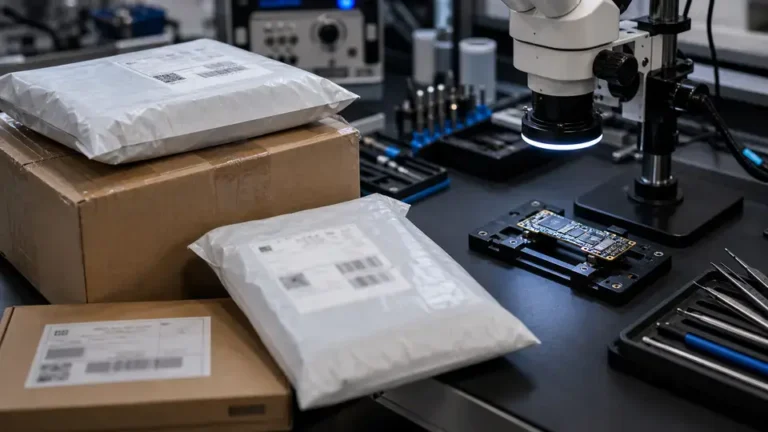
Board-level repair is more work, and that is the whole point. The shop that swaps the board is choosing the easy path with your money and your data. We chose the harder one eleven years ago. If your device won’t power on, won’t charge, or got a board quote that made you wince, bring it in or mail it to us tracked, and we’ll find the one part that failed.