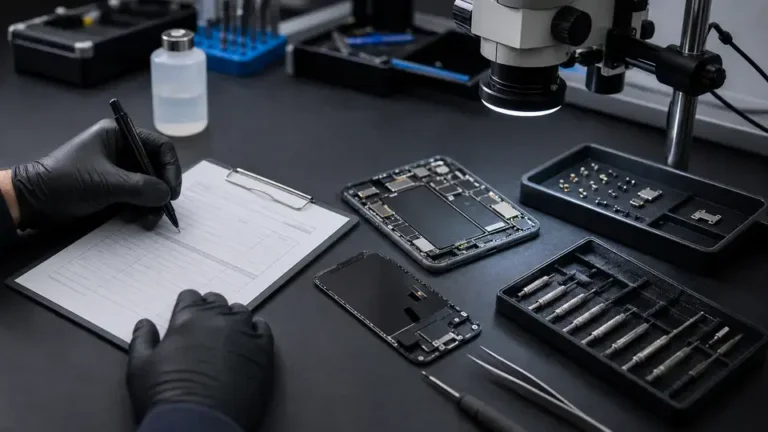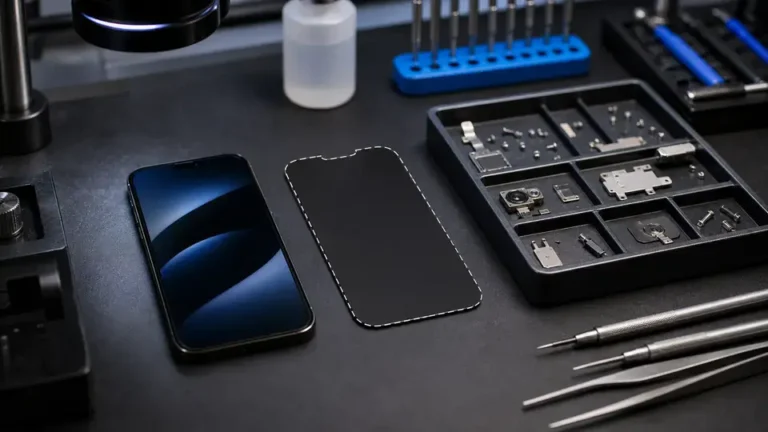



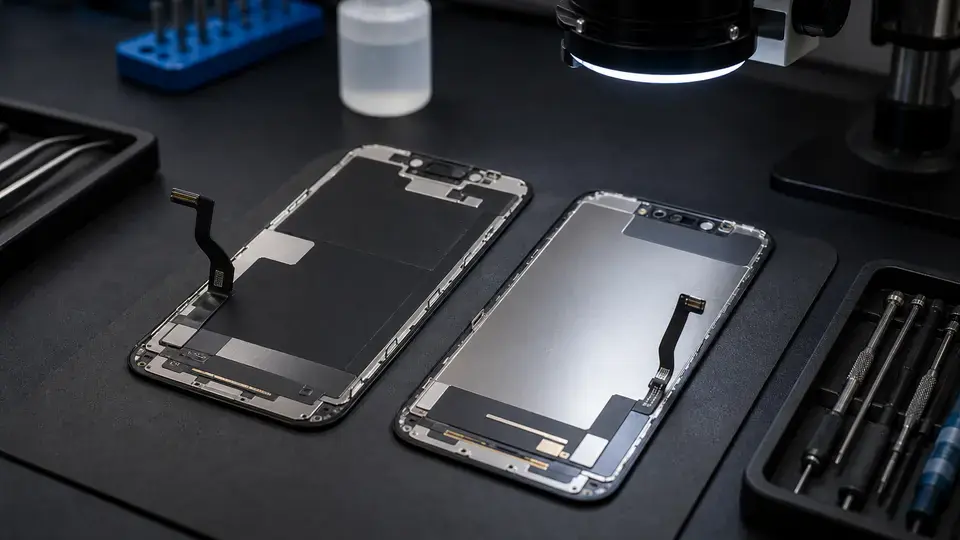
When your screen cracks, the question we hear most is not “how much” but “is it the real one?” It is the right question, and the honest answer has more shades to it than most shops let on. There is genuine OEM glass, there is quality aftermarket, and there is the cheap stuff. They do not cost the same, and they do not behave the same on your Repair Center three months later. After eleven years of nothing but board-level and component repair, here is how we talk our own customers through the choice.
The three tiers, plainly
“Aftermarket” is not one thing, and lumping it all together is how people get burned. We sort replacement displays into three honest buckets:
- Genuine / OEM OLED: the same panel technology the phone shipped with, from the original supply chain or a verified equivalent. Self-emitting pixels, true blacks, full rated brightness, and the calibration data the phone expects from the display flex.
- Quality aftermarket OLED (soft/hard OLED): a real OLED panel built by a third party. Color and contrast are close to original. The better ones now restore ProMotion 120Hz on Pro models that originally had it.
- Cheap incell / LCD: a backlit LCD pretending to fill an OLED phone’s shoes. Lower contrast, no true blacks, washed-out color in sunlight, a slightly thicker profile, and a hard cap at 60Hz.
What actually changes day to day
The spec sheet is one thing; living with the phone is another. Brightness is the most visible gap. Genuine panels hit their full rated peak; reputable aftermarket OLEDs land in a respectable range; budget incell screens dim noticeably and struggle outdoors. Color and contrast follow the same order, and an incell panel in an OLED phone never gives you those deep blacks back.
Then there is refresh rate. If your phone came with ProMotion, a 60Hz incell replacement makes scrolling feel stiff, even if you cannot name why. Touch feel varies too: the cheap panels often use a different oleophobic coating, so your finger drags more and fingerprints show faster. None of this makes a budget screen useless. It makes it a budget screen, which is sometimes exactly the right call.
The iPhone warning, explained without scare tactics
On modern iPhones running recent iOS, the phone reads a small authentication chip on the display flex and reports back. In Settings under Parts & Service History you may see the display listed as “Genuine,” “Used,” or “Unknown,” and a non-genuine panel can trigger an “Important Display Message” or an “Unknown Part” notice. That warning sounds alarming, so let us be precise about what it does and does not mean.
“Unknown Part” means the phone could not verify the display’s origin. It does not mean the screen is broken, and it does not brick your phone.
What it can affect is True Tone and auto-brightness, which lean on the display’s original calibration and the front ambient/flood sensor flex. With a genuine reused panel, we transfer the original OLED driver chip and sensor flex by hand and recalibrate, which usually keeps these features working. With aftermarket glass, True Tone may not behave and the notice typically stays. We tell you up front which features survive on your exact model, because that is the part people actually care about.
Samsung is a different problem entirely
Samsung’s flagship AMOLED panels are fused: the glass, the AMOLED layer, the digitizer, and often the frame are bonded into one assembly. There is no clean “just the glass” repair on these. When the glass cracks, the honest fix is a full assembly swap, and a genuine Samsung service part costs real money because you are replacing the whole sandwich. Aftermarket Samsung assemblies exist and can be reasonable on older or mid-range models, but on a current flagship the gap between a true Samsung panel and a copy is easy to see side by side. We will show you both before you decide.
When aftermarket is the smart, honest choice
We are not OEM purists. There are clear cases where a quality aftermarket screen is the rational pick, and we will recommend it ourselves:
- The phone is several years old and you are nursing it along until an upgrade.
- It is a backup phone, a kid’s phone, or headed for resale where cost matters more than peak brightness.
- You crack screens often and would rather spend less per repair.
- The original-glass model is an LCD phone anyway, where the quality gap is much smaller.
OEM earns its premium when you are keeping a newer phone for years, when True Tone and ProMotion matter to you, or when you want the resale value and warning-free status that only a genuine panel preserves. Neither answer is “right” in the abstract. It depends on your phone and your plans.
How we back each choice
Our warranties reflect what each part can honestly promise. Genuine OEM and OEM-equivalent OLED repairs carry a one-year warranty. Aftermarket parts carry a 30-day warranty, because that is the realistic confidence window for that tier, and we would rather quote it straight than oversell it. Every job starts with a $65 written diagnostic that applies toward your repair, so you see the panel options and the trade-offs in writing before anything is opened.
Whichever way you lean, we will lay out genuine versus aftermarket for your specific model in plain terms. Start with our screen replacement service, or go straight to the details for iPhone screen replacement or Samsung screen replacement. Walk in to our Clarendon lab in Arlington, or mail it in tracked from anywhere in the fifty states. We will tell you what you are actually choosing.