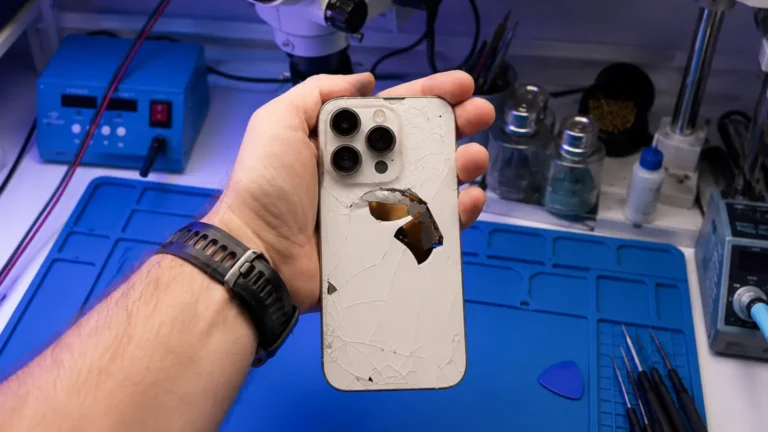



A customer mailed us an iPhone 12 Pro that three shops had already “tried.” It powered on, showed the Apple logo, then rebooted in a loop forever. The last shop told him the CPU needed reballing and quoted him a number that made his eyes water. We put it at the Repair Center. The real fault was a cracked solder joint under the NAND, not the CPU at all, a reball, yes, but of the storage chip, and a fraction of the drama. That gap, between what people think reballing is and what it actually fixes, is why we wrote this.
What does reballing actually mean?
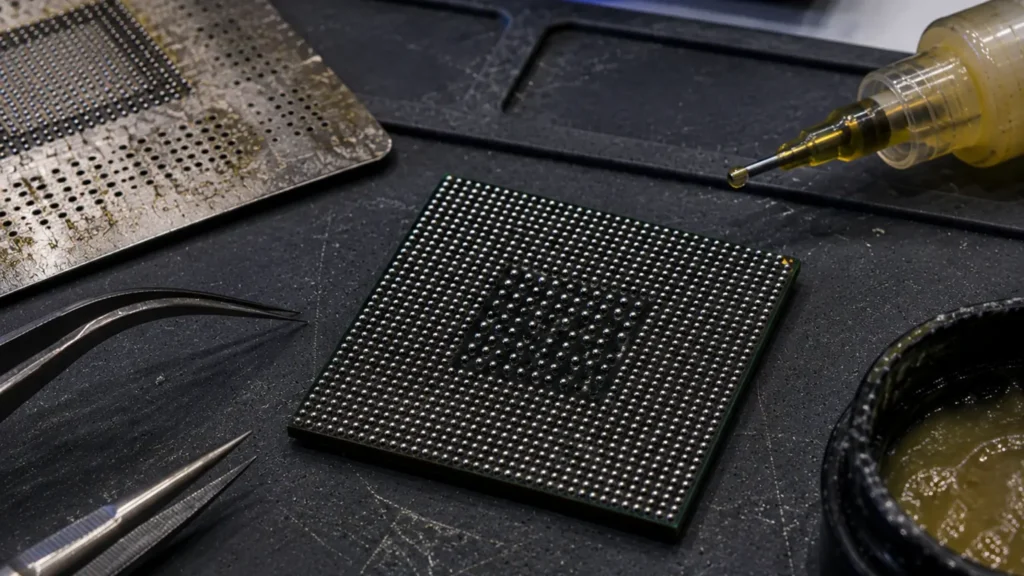
Modern phone chips don’t have legs you can see. The CPU, the NAND/UFS storage, the PMIC, they sit on the board as BGAs, Ball Grid Arrays. Underneath each one is a grid of microscopic solder balls, sometimes hundreds of them, each connecting one pad on the chip to one pad on the board. On a phone CPU those balls can be 0.3mm or smaller, packed tighter than the holes in window screen.
Reballing is exactly what it sounds like. You heat the chip until those balls melt, lift it off the board, clean every trace of old solder off both the chip and the board, then lay down a fresh, perfectly uniform grid of new balls on the chip’s underside using a stencil. Then you place it back and reflow it home. New balls, new joints.
People say “reballing” loosely to mean any chip-off work. Strictly, it’s the rebuilding of the ball grid, and that’s the part that’s hard.
When does a phone actually need it?
Less often than the internet implies. In 11 years at the Repair Center, true CPU reballing is one of the rarer interventions we perform. Here’s the honest breakdown of when a chip genuinely needs to come off and get reballed:
- A cracked or fatigued ball grid. Drops and flex can crack the joints under a big chip. Symptoms: boot loops, random reboots, intermittent no-display. The chip is fine; the connection isn’t.
- Liquid corrosion that reached under the chip. When electrolytic gunk creeps beneath a BGA, you can’t clean what you can’t reach. The chip has to come off.
- A failed prior reflow. Someone “baked” the board with a heat gun, partially melted things, and now joints are bridged or open. We’ve seen plenty of these.
- Transplanting a chip. Moving a NAND from a dead board to a donor for data recovery, the chip gets reballed before it goes onto the new board.
What does not need a reball: most no-power boards (usually a shorted cap, a dead PMIC rail, or a charging IC), most “no charge” faults (Tristar/Tigris U2), most audio and backlight failures. Those are diode-mode-and-replace jobs. If a shop reaches for “reball the CPU” as a first answer, be skeptical. At our Repair Center, reball is a conclusion we arrive at after measurements, not a starting guess.
Why is it so hard?
Three reasons stack up.
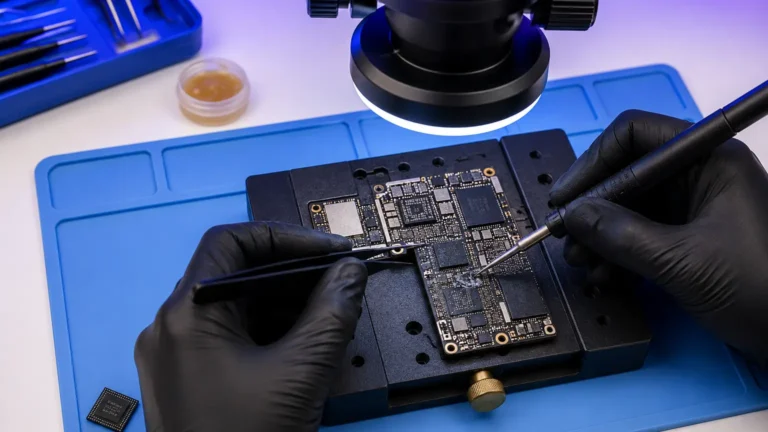
Heat is a weapon that cuts both ways. To melt the balls you push the chip to around 217°C for lead-free solder. But the board next door has plastic connectors, glued shields, and other chips that hate heat. We work with controlled hot air, a preheater warming the whole board from below, and thermocouples watching temperature so we don’t cook the patient to save it. Too cool and joints don’t form; too hot and you lift pads or warp the board.
Everything happens under a microscope. At 0.3mm pitch you cannot align a chip by eye. Place it a hair off and balls bridge to their neighbors, an instant short. We align under magnification, often watching the chip “self-center” as the solder surface tension pulls it onto its pads during reflow. That self-centering is beautiful when it works and is the whole reason BGA assembly is even possible.
The board underneath is fragile. Phone boards are thin, multi-layer, and the copper pads under a chip can lift right off if you drag a hot chip sideways or apply flux-less heat. A lifted pad on a CPU power or data line can mean the board is done. We’ve turned away boards where a previous “repair” tore pads we couldn’t jumper back.
How we do it, start to finish
- Diagnose first. $65 honest diagnostic. We confirm the chip is the problem, diode-mode readings, rail voltages at the Repair Center PSU, sometimes thermal imaging to spot a shorted chip drawing current. We don’t pull a chip on a hunch.
- Remove the chip. Flux it, bring it up to temperature with controlled hot air over a preheated board, and lift it cleanly with tweezers or vacuum once the balls are molten.
- Clean both surfaces. Drag-solder and braided wick to strip old solder off the chip and the board pads, then flux residue off with solvent until both are mirror-flat. This step makes or breaks the job.
- Reball the chip. Seat the chip in a stencil sized to its pad map, apply solder paste or place pre-formed balls, and reflow so a uniform new grid forms on the underside.
- Place and reflow. Align under the microscope, reflow, and watch for self-centering. Then verify.
- Test before it leaves. Boot, run it, stress it. A reball that boots once and dies in a pocket is a fail.
Is it worth it?
Sometimes yes, sometimes no, and we’ll tell you which. For a flagship with a cracked NAND joint and irreplaceable photos, a reball that recovers the data is worth every cent. For a three-year-old budget phone with a corroded CPU, the honest answer is often “buy another phone.” We say that out loud. We’d rather lose the job than take your money on a coin-flip when a clean board would cost you less.
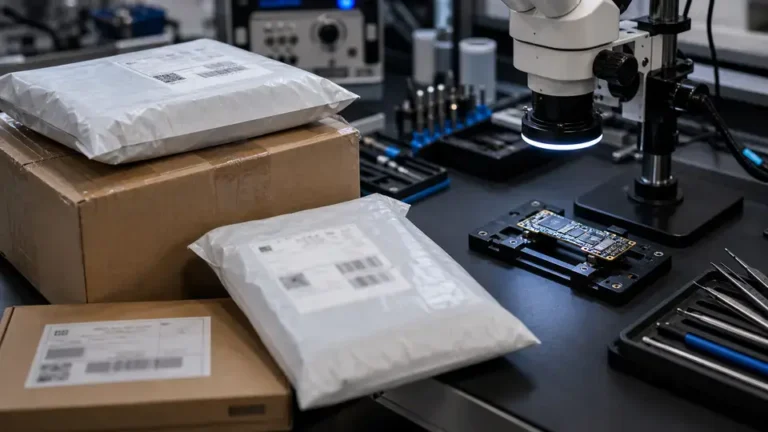
Reball work carries our standard warranty, 1 year on OEM/OEM-equivalent parts, 30 days on aftermarket. The work is in the DMV at our Arlington/Clarendon lab, or nationwide by mail-in if you’re shipping us a board.