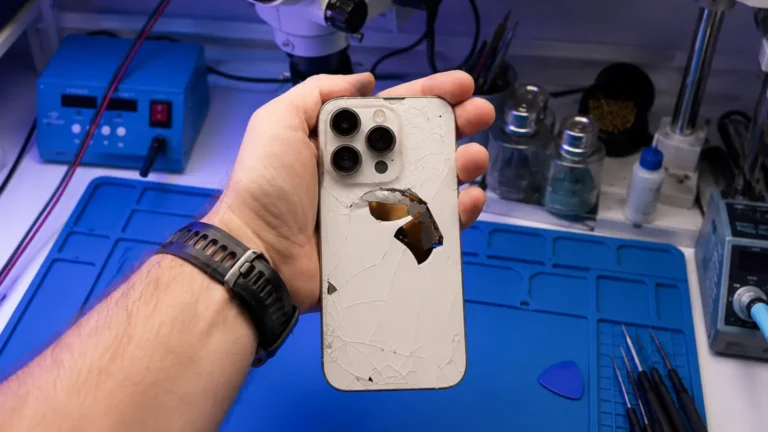



Last month a screen-and-battery shop two Metro stops away dropped off a MacBook Pro in a static bag with a sticky note: “no power, customer spilled coffee, we replaced the battery, still nothing, yours now.” At the Repair Center it drew 0.00A at the Repair Center PSU, then snapped to a dead short at 0.4V the second we nudged the rail. That is not a battery job. That is a corroded PPBUS short under the SMC, and it is exactly the kind of board the shop that sent it has no business opening, and smartly didn’t.
We are, quietly, the shop a lot of other shops send their boards to. That referral work isn’t a sideline. It’s a core part of what keeps our microscope busy.
Why would a repair shop mail its own jobs away?
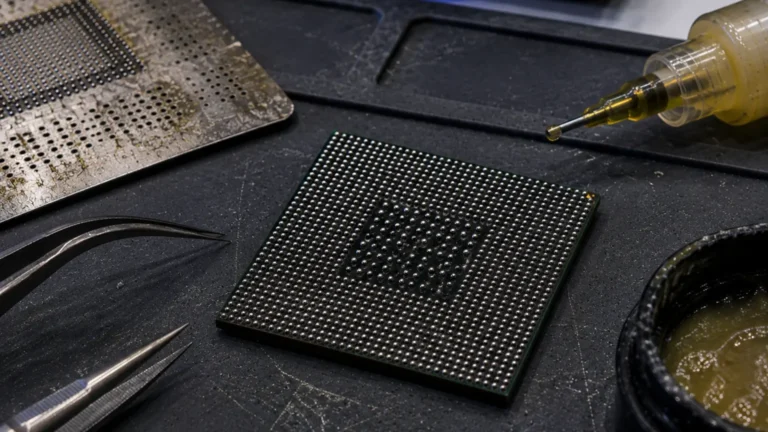
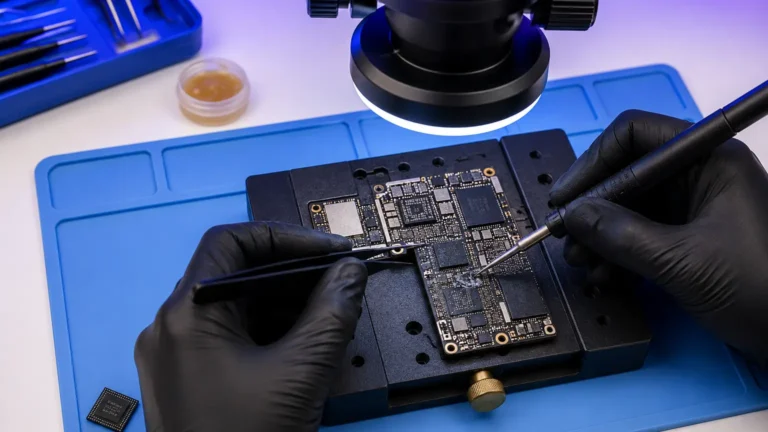
Because the economics of board-level repair are brutal and most front-counter shops know it. To do this work properly you need a stereo microscope, a regulated Repair Center PSU you can read to the milliamp, hot air dialed in for lead-free BGA, a good preheater, schematics and boardview files, and, the part nobody can buy, the reps. Reballing a Tristar/Tigris U2 charging IC or a Tigris audio codec without lifting pads is a skill you earn over hundreds of boards, not a tool you order.
A shop that does 15 screen swaps and 8 batteries a day cannot also be the person who spends two hours in diode-mode chasing a short on a single logic board. The math doesn’t work, and the failure rate when a generalist tries it is ugly. So the honest move, the one that protects their customer and their reputation, is to send the board to someone who lives on the microscope. That someone is us.
What kinds of boards land at our Repair Center from other shops?
Of the last ~60 boards mailed or dropped in by partner shops, the breakdown looked roughly like this:
- No-power / dead short, the biggest bucket. Liquid-damaged MacBooks and iPhones drawing a short on a main rail, blown PMIC, shorted backlight boost. The work is finding the one failed component on a 1,000-part board.
- Charging / no-recognition, Tristar/Tigris U2 charging IC and its support circuit, USB-C / Lightning flex tristate issues, “won’t charge past 1%” that a battery swap never touched.
- Failed ICs needing reball or replace, audio IC (“loop disease” on older iPhones, grayed-out speaker, stuck on headphones), baseband, NAND/UFS issues.
- Reballing and reflow, GPU/CPU reballing on older MacBooks, BGA work the sending shop simply can’t run.
- Lifted pad / failed prior repair, and we’ll say it plainly: a chunk of this is boards another shop or another customer already attacked. A torn pad after a sloppy connector swap, a jumper that needs rerunning. We fix it and we tell the truth about what we found.
- Data recovery, the device is dead and the customer never backed up. We’re recovering the photos off the NAND, not saving the phone.
How fast, and what does it cost the shop?
Standard Repair Center turnaround on a board-level case is 3-5 business days once it’s in hand, faster on common iPhone charging and audio IC jobs, longer on a nasty multi-rail liquid board or a data recovery that needs NAND work. We don’t quote a real number until the board is open under the scope and the diagnostic is done, because guessing over the phone is how you lie to people.
Every board gets the same $65 diagnostic as a walk-in, credited toward the repair if the partner shop greenlights it. We give the sending tech the actual finding, “C-rail short to ground, PMIC, here’s the diode reading”, not a vague “it’s the motherboard.” Shops can mark that up to their own customer however they like; most do. The relationship works because the diagnosis is honest enough that they can stand behind it at their own counter.
In 11 years we have never poached a partner shop’s customer. The board comes from them, the repaired board and the diagnosis go back to them. That’s the whole deal, and it’s why the same shops keep mailing us work.
Chain-of-custody: how a board moves through here
A logic board is somebody’s irreplaceable data and somebody else’s business reputation, so we treat custody seriously.
- Intake, board photographed on arrival (both sides, under the scope), logged with an intake ID, sending shop, and reported symptom. We note pre-existing damage before we power anything, so there’s no argument later about who lifted what.
- Diagnosis, Repair Center PSU current-draw reading, diode-mode short hunt, finding documented against the intake ID.
- Approval, finding and price go back to the sending shop. Nothing gets soldered until they say go.
- Repair and verification, the work, then a real function test, then photos of the repaired area.
- Return, board back in antistatic packaging, tracked, with the diagnosis notes.
How to send us a board (shop or end user)
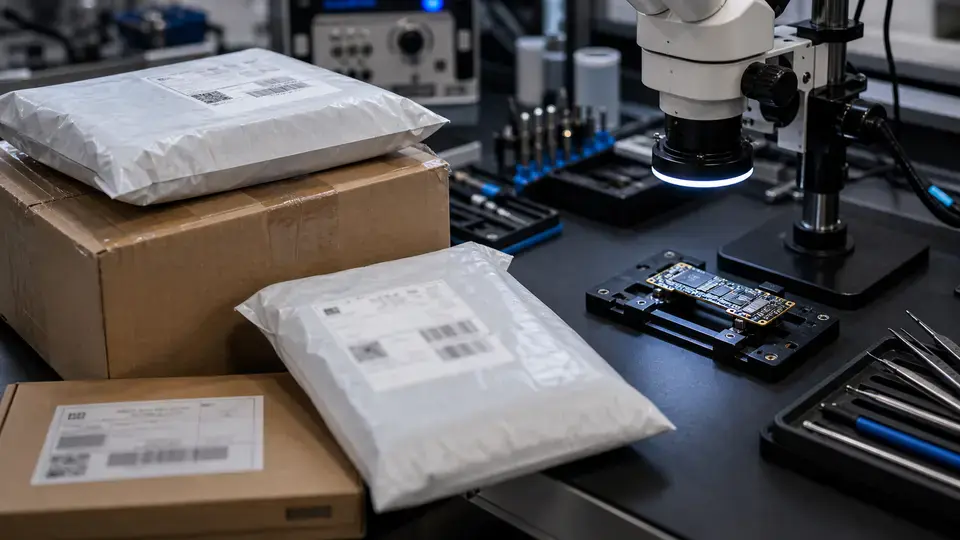
Bag the board in antistatic, not bubble wrap against bare PCB. If it’s a phone, you can send the whole device; if it’s a MacBook, the logic board alone is fine and cheaper to ship. Include the symptom, what’s already been tried, and whether data recovery matters, because that changes how aggressively we treat the NAND. We serve walk-ins across the DMV from the Clarendon lab and take nationwide mail-in.
One honest caveat: not every board comes back. Some liquid boards are too far gone, some prior repairs tore too much copper to rebuild economically, and we’ll tell you that fast rather than running up hours on a lost cause. The $65 still buys you a straight answer and, where the device is truly dead, a real shot at the data.