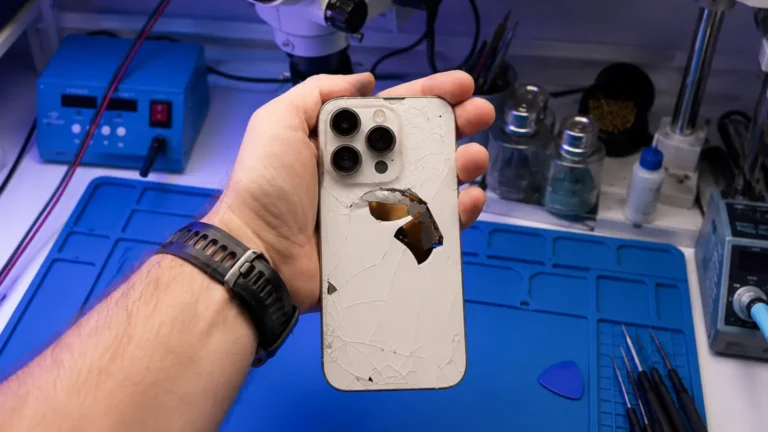



A customer drove in last month with an iPhone 14 Pro that two other shops had quoted at “needs a new board, $599, data is gone.” We put it at the Repair Center PSU: 0.00A on power, then a hard short pulling the main rail to 0.7V the second we forced a boot. That is not a dead board. That is one shorted component talking. Twenty minutes in diode-mode found it, a tantalum capacitor near the PMIC that had cracked and shorted. We pulled it, cleaned the pad, and the phone booted. Data intact. The “new board” those shops wanted to sell would have thrown away the only thing the customer actually cared about: the photos.
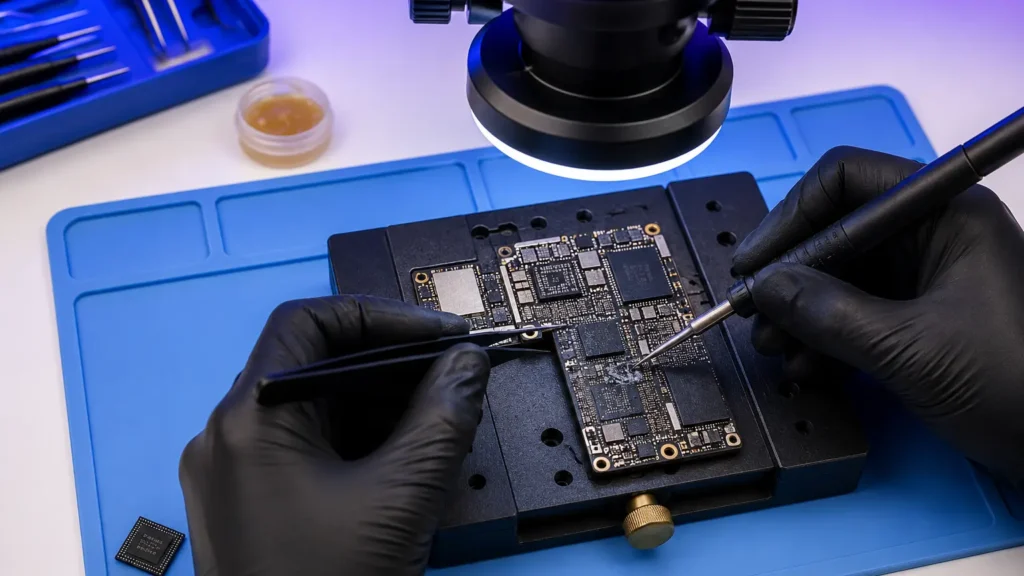
That gap, between swapping the whole board and fixing the one part that broke, is what board-level microsoldering is. It is also the single most misunderstood thing in this trade.
What does “board-level” actually mean?
Your phone’s logic board is a slab of fiberglass with maybe a hundred individual components soldered onto it: power management ICs, the charging IC (Apple calls theirs Tristar, then Tigris, the U2 chip), audio ICs, the NAND or UFS that holds all your storage, the backlight boost circuit, regulators, hundreds of passive caps and resistors. When one fails, the whole device misbehaves. The board is not dead. One occupant of it is.
Board-level repair means we isolate which component died and replace or repair that component while leaving everything else, including the storage chip with your data, untouched. The opposite, what nearly every storefront does, is whole-board replacement: rip out the entire board, drop in another, and hope. We call it part-swapping, and it has its place. But on a phone, the board is your data. Swap it and your photos are gone unless you had a backup.
Why “just swap it” is the whole industry
Honestly? Because microsoldering is hard and slow, and swapping is fast and idiot-proof. To do board-level work you need a stereo microscope, hot air at controlled temperature, a Repair Center power supply you can read to two decimal places, schematics and boardview files, and, the part you cannot buy, years of reps reading shorts and lifting chips without cooking the board next to them.
A screen swap takes 30 minutes and a tray of tools. A logic-board repair can take hours of probing a circuit nobody published a map for. So the business model of the average mall kiosk is: screens, batteries, charge ports, and “sorry, it’s the board, we can’t help.” That last sentence is usually true for them. It is rarely true.
Of the last ~50 “dead, needs a new board” phones that came to us as second opinions, the real fault was a single board-level component on more than 30 of them. The board was fine. One part on it wasn’t.
BGA, reballing, traces and pads, the vocabulary
A few terms get thrown around, so here is what they mean at the Repair Center, in plain English:
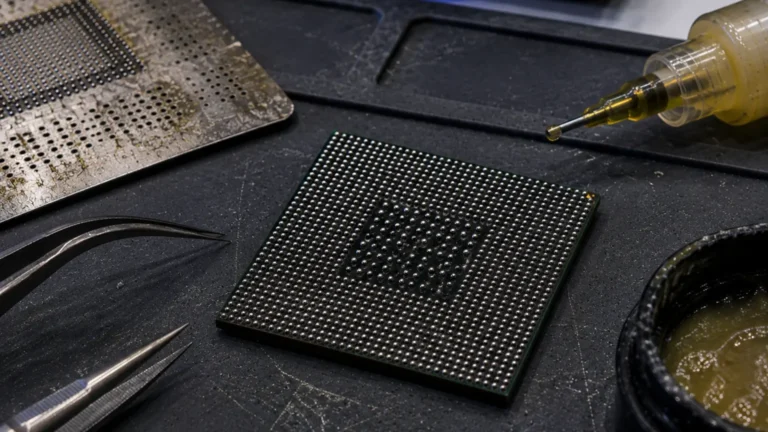
- BGA (Ball Grid Array): the big chips, NAND, the CPU, the PMIC, don’t have legs you can see. They sit on a grid of tiny solder balls underneath, hidden. You can’t touch those joints with an iron. They’re under the chip.
- Reballing: when we remove a BGA chip, the old solder balls come off messy. Reballing is rebuilding that grid of balls, dozens to hundreds of them, perfectly aligned on a stencil, so the chip can be re-seated. It’s the difference between a repair that holds and one that fails in a week.
- Traces: the hair-thin copper wires printed inside and across the board that connect components. Liquid corrosion and drop damage eat them. A broken trace means we run a jumper, a tiny wire bridging the gap by hand.
- Pads: the little copper landing spots a component solders to. Yank a connector or overheat a chip and you get a lifted pad, the copper tears off the board. Now you’re rebuilding the landing point before you can even start the real repair.
None of that exists in the swap-it world. It is a different job with different tools and a different failure rate.
When NOT to do it, we’ll tell you
Board-level repair is not always the right call, and we say so. If a board has soaked in salt water for a week and the corrosion has eaten under the CPU and into the inner layers, sometimes the honest answer is: this is a data-recovery job, not a repair. We’ll harvest your data off the NAND and tell you to buy a different phone rather than charge you for a board that will fail again in a month. We’ve turned away “repairs” that we could technically attempt because the odds didn’t justify your money.
That’s the diagnostic. It’s $65, it’s real Repair Center time on the PSU and under the scope, and it gets credited toward the repair if you go ahead. You’re paying for an honest answer, not a guess.
Why this is our whole thing
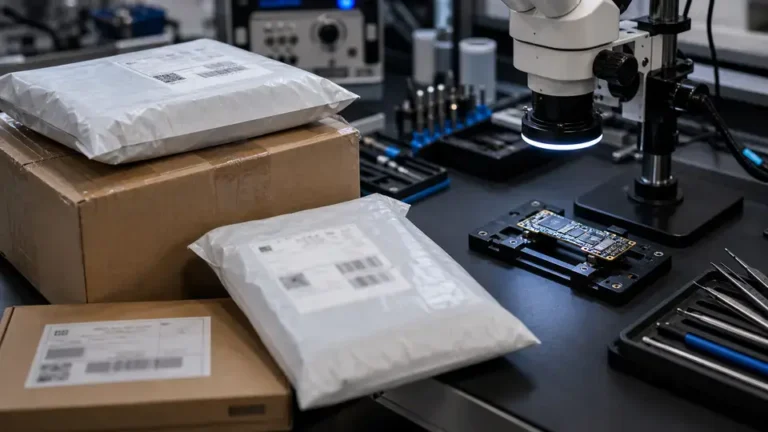
Eleven years at the Repair Center, and microsoldering and logic-board repair is what we built the Arlington lab around. It’s why people mail us boards from across the country after the local shop shrugged. The differentiator isn’t marketing, it’s that when your phone draws a dead short at 0.7V, we read it as a clue instead of a death certificate.